Musical memory survives against the odds
Today I have been reading a new article with another amazing story of how musical memory can survive in the face of neurological injury and/or illness.
These extreme cases are rare, but they tell us something crucial about the nature of musical memory – that it is uniquely vivid and long lasting, as well as being personal for each individual.
I have always been convinced that there are great things to be gained by learning more about how musical memory works; so much we can understand about how to maximise memory in general and how to recover memory in difficult cases of dementia and other neurological conditions.
Musical memory has long been one of my favourite areas of study in psychology. I remember first being captivated by stories of musical memory when learning about amnesia patients during my undergraduate degree. I was lucky enough to be taught by Alan Baddeley, and he described the cases of amnesia that he had worked with over forty years in a great deal of detail and with a great amount of compassion.
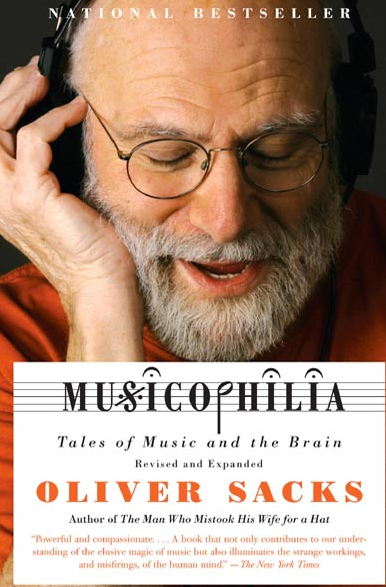 I then followed Oliver Sacks as he described many cases of remarkable musical memory in neuropsychology patients as part of his book Musicophilia; both stories of extreme survival in memory and tales of how memory for music can stimulate a person in an otherwise largely catatonic state.
 We are all now probably familiar with a recent youtube video that is akin to such a story, but if not please visit here for instant inspiration. “He is being animated by the music”. The video shows dramatically how music can bring people back to themselves, restoring identity much like a key opening the door to your own home after a long journey away. Once again you are instantly surrounded by your own ideas, thoughts and belongings. You have been transported to the place where you feel most like you again – music can do this for you.
The new study by Carsten Finke and colleagues is the story of a 68 year old professional cellist, called PM in the paper, who has developed severe amnesia following encephalitis, a often fatal viral infection that causes the fluid in the brain to swell. In PMs’ case, his illness left him with brain lesions in his right medial temporal lobe, large parts of his left temporal lobe and parts of the left frontal and insular cortex.

PM was an accomplised cellist and played in German orchestras for many years. Now, following his illness, he has severe memory problems. According to standardised testing with the Wechsler Memory Scale and interviews he has deficits in memory for events (episodic memory) and for facts (semantic memory). He remembers his brother and his full time care giver; no-one else.
In the musical domain he can’t recognise lyrics, name any famous cellists and the only composer he can remember is Beethoven. But he can still sight read and play cello.
In the new paper the authors tested his retrograde musical memory (memory for music heard before his illness) and anterograde musical memory (memory for music only composed after his illness). They played him a selection of songs then some time later they played him some of the songs from the first session alongside some new ones that were matched for musical character and instrumentation. 5 age matched string players from the Berlin Philharmonic also completed the tests. Everyone passed with flying colours.
PM could also discriminate famous from non famous pieces in his past just as well as the control participants. The doctors tested his ability to learn complex new music – again he performed as well as the matched musicians. They tested him for amusia (unsurprisingly, he did not have it).
Then they tried similar tests with both objects and faces; PM’s performance on these tasks was very bad, significantly worse than that of the musicians.

PM is a case of isolated memory preservation, as is Clive Wearing (although Clive is a more severe case) – his musical memory of his past seemingly survives when his memory for almost everything that he as ever seen or done has slipped away. He can also learn about new music which is an exciting finding.
This case suggests that the representation of music is different in the brain. I don’t quite agree. I have yet to be convinced that musical memory is separate from other memories; I think a more parsimonious explanation is that musical memory is simply made of stronger stuff.
In my research with Alan Baddeley I learned never to suppose that a new type of memory exists unless the case for it is strongly justified, unless you can’t explain the memory performance you see with the systems already thought to exist. And you can in fact hypothesize that music is laid down in a unique way in memory using all the tools that we already know about – just stronger codes (more elaborate) with more links into other parts of the brain such as emotion.
In general, the evidence is mounting that musical memory is a uniquely powerful tool to stimulate and revive the memory. Let us all hope for a future where this power is fully understood and used for all our benefit.
Link to the paper cited in this blog


10 Comments
Guang Yi
This is EXACTLY the type of memory research I’m interested in! I’m glad there are some papers coming out regarding this. I will be reading this paper very carefully. Thank you for sharing!!
Pingback:
Christine Green
Thank you so much for this. This information is great for my research for my dissertation on Music, Emotion and Memory. I look forward to seeing what you post next.
Christine
vicky
You are very welcome, thanks in return for the lovely comments!
All the best,
Vicky
Ladan
I absolutely love the site and useful information! really helped my research, too, and I’m glad it’s being updated so faithfully.
I just have one thing to say about the Sacks book, which is obviously interesting but he doesn’t explain the cognitive background at all at all, and I find myself frustrated by every book that just enumerates cases that are fascinating but never quite get “there”.
But anyway, eagerly awaiting many more posts!
art
You say musical memory is made of strong stuff. Isn’t it the case that a professional cellist has a strong musical memory just like a stampcollector has a strong memory for stamps?
vicky
Yes in a sense you are right, memory experts tend to be specialists. But having said that music is one of the few fields identified so far where you seen to see ‘transfer’ into a general boost in memory ability. This does not tend to happen in other types of memory expert, although I do not know of a study that has been stamp collectors – good idea for a project! Also, I mean to say that memory for music is strong because it often survives much longer than other types of memory in cognitive decline.
Best,
Vicky
vicky
Thanks for the kind words, they are very much appreciated! I tend to agree that neuropsychological cases can be very inspiring and amazing to read but frequently lack the depth of explanation that really tells us very much about the brain/ cognitive processing in general.
All the best,
Vicky
Benjamin
hey Vicky,
I’m a senior in high school doing an exopostion, which is required to graduate, on musical memory and reasponse and I would greatly appreciate it if you could help me with some questions I have?
thank you, Benjamin Kerner
vicky
Hi Benjamin. As it happens I have had many requests like this in the past few weeks and I am afraid for the moment I have to draw a line and say no as I need to catch up on my College work! You might consider contacting other experts in musical memory such as Professor Andrea Halpern, Professor Lola Cuddy or Professor Aaron Williamson? All the best, Vicky